
WELCOME BONUS 300%
UP TO €2000 + 100
FREE SPINS
UP TO €2000 + 100
FREE SPINS
Home → Blackjack
Blackjack at Gorilla Casino: Variants, Rules and Payouts
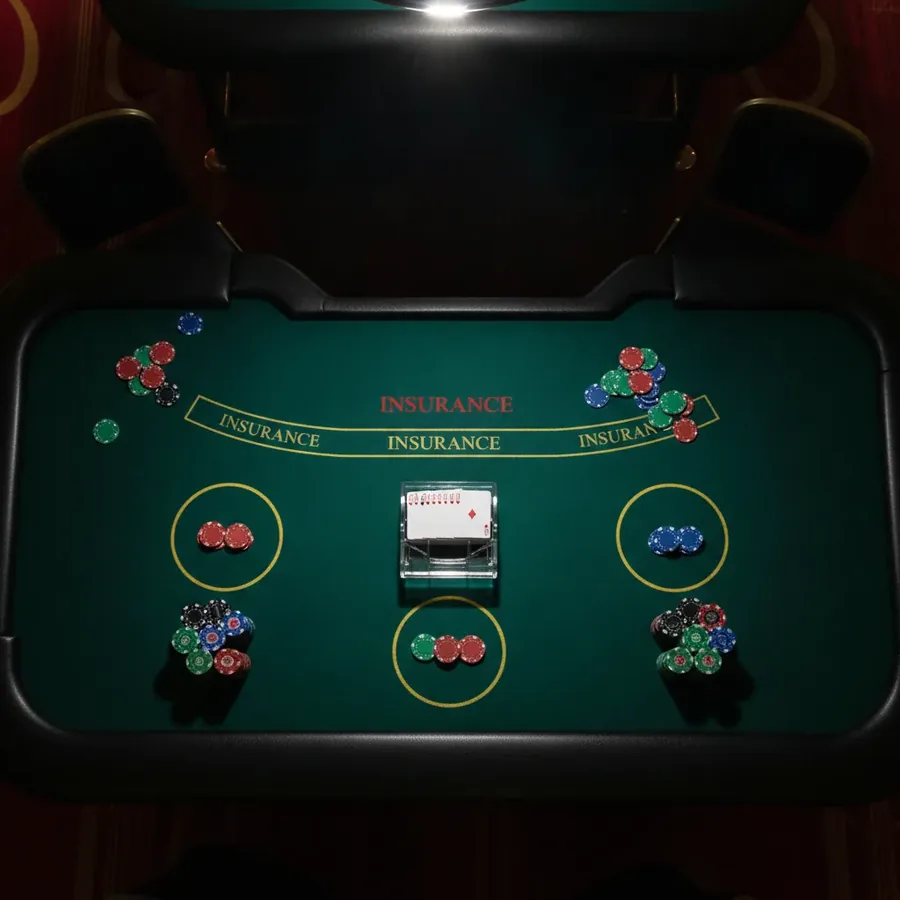
Error insurance: 7 percent additional house edge
The Blackjack Insurance side bet is offered when the dealer reveals an Ace, with payouts at 2:1. This bet carries a house edge of 7.47%, based on a 6-8 deck shoe. Basic strategy dictates players should always decline this bet, unless card counting indicates a true count of +3 or higher.
Accepting the insurance bet, particularly in a single-deck scenario, can theoretically shift the advantage to the player by approximately 5.88%. However, for the majority of players who do not employ advanced card counting techniques, this side bet represents a significant disadvantage.
This means that for every 100 EUR wagered on the insurance bet over the long term, an average of 7.47 EUR is retained by the casino, impacting the overall return to player significantly compared to the main game.
Live stream with three cameras and OCR
Infinite Blackjack, provided by Evolution, offers unlimited seating at the table, accommodating a high volume of players. This live dealer game includes four distinct side bets: Any Pair, 21+3, Hot 3, and Bust It, adding extra wagering opportunities. The stated RTP for Infinite Blackjack is 99.47%.
Lightning Blackjack, also from Evolution, similarly provides unlimited player positions and features dynamic Lightning multipliers that can boost winnings up to 25x on a hand. This variant boasts a higher RTP of 99.56%, making it potentially more favorable for players.
These live dealer options, including Blackjack Party, aim to provide an engaging environment, with Infinite and Lightning Blackjack specifically catering to those who prefer continuous play without waiting for a seat at traditional tables, with bets ranging up to 5,000 EUR.
One Deck vs Eight Decks in House Edge
A single-deck Blackjack variant with classic rules and a 3:2 payout offers a house edge of just 0.15%, demonstrating the significant impact of fewer decks. This is a reduction of approximately 0.48 percentage points compared to an eight-deck game.
Conversely, a standard six-deck game with rules such as S17 (Dealer Stands on Soft 17), DAS (Double After Split), and DOA (Double on Any Two Cards), along with a 3:2 payout, results in a house edge of 0.46%. This specific combination is highly favorable when playing with basic strategy.
The reduction in decks directly lowers the house edge; for instance, a single deck game provides a much lower casino advantage than a game played with eight decks, making it a more attractive option for players focused on minimizing the inherent casino advantage.
What Percentage Does Blackjack Count Towards Bonus?
Table games, including Blackjack variants like Blackjack Liberal Vegas Strip, contribute only 10% towards fulfilling bonus wagering requirements. This means that for every 100 EUR wagered on blackjack, only 10 EUR counts towards clearing the bonus.
The Blackjack Liberal Vegas Strip variant itself offers a highly favorable RTP of 99.72% with a house edge of 0.28%, due to its liberal rules such as S17, DAS, Resplit, and Late Surrender. Despite its favorable odds, its contribution to bonus wagering remains low.
This low contribution percentage means that high rollers aiming to clear bonus offers primarily through table games would need to wager significantly more to meet the requirements compared to playing slots, which contribute 100%.
Bonus 100 EUR with 10 percent credit
The welcome bonus offers 300% up to €2,000, plus 100 free spins, presenting a substantial initial boost for new players. To illustrate, a deposit of 100 EUR would yield a bonus of 300 EUR, bringing the total to 400 EUR for play.
However, the contribution of table games to the wagering requirements is limited to 10%. Therefore, if a player focuses solely on blackjack to clear a bonus, 100 EUR wagered on blackjack only reduces the wagering requirement by 10 EUR.
This implies that to fulfill a wagering requirement of, for instance, 4,000 EUR through blackjack alone, a player would need to wager a total of 40,000 EUR, highlighting the impact of the 10% contribution rate on bonus clearance for high rollers.
Blackjack variants at a glance
| Variant | Payout | House edge | Rule | Bet range |
|---|---|---|---|---|
| Blackjack Surrender (Late Surrender) – Regel-Effekt | n.a. (Regel-Modifikator) | −0.08 Prozentpunkte | Spieler gibt Hand nach Dealer-Blackjack-Prüfung auf, verliert die Hälfte des Einsatzes. Verbessert RTP um ca. 0.08 Prozentpunkte. Early Surrender ist wesentlich wertvoller (bis −0.6 Prozentpunkte), aber extrem selten. | Rückzahlung 50% des Einsatzes |
| Blackjack Split / Double / H17 – Regel-Effekte | n.a. (Regel-Modifikatoren) | H17 +0.22 Prozentpunkte; RSA −0.08 Prozentpunkte; DAS −0.14 Prozentpunkte | Dealer Hits Soft 17 verschlechtert RTP um 0.22 Prozentpunkte; Resplit Aces verbessert um 0.08 Prozentpunkte; Double After Split verbessert um ca. 0.14 Prozentpunkte; 6 Decks statt 8 – ca. 0.02 Prozentpunkte. | Double – Einsatz ×2 mit einer Karte; Split – bis 4 Hände; Ass-Split meist mit einer Karte. |
| Blackjack Insurance / Versicherung (6–8 Decks) | 92.53% | 7.47% | Separate Nebenwette bis 50% der Hauptwette, wenn der Dealer ein Ass hat. Basisstrategie schreibt IMMER Ablehnung vor (außer Karten zählen bei True Count ≥ +3). Bei einem Deck Vorteil ≈ 5.88% | Insurance 2:1 |
| Blackjack Ein Deck, klassische Regeln, 3:2 | 99.85% | 0.15% | Weniger Decks = niedrigerer Vorteil; ein Deck gibt ca. −0.48 Prozentpunkte gegenüber 8 Decks. Oft durch 6:5 Auszahlung kompensiert. | Blackjack 3:2, Gewinn 1:1 |
| Blackjack Liberal Vegas Strip (liberale Regeln, 3:2) | 99.72% | 0.28% | Günstigste Regelkombination: S17 + DAS + Resplit + Late Surrender. Standardabweichung 1,15 | Blackjack 3:2, Gewinn 1:1 |
| Blackjack Auszahlung 6:5 statt 3:2 (6 Decks) | 98.15% | 1.85% | Ersatz von 3:2 durch 6:5 fügt exakt +1.39 Prozentpunkte zum Vorteil des Casinos hinzu – stärker als jede andere Regeländerung. Bei $10 Einsatz zahlt Blackjack $12 statt $15. | Blackjack 6:5, Gewinn 1:1 |
Bust at 22: Stake Lost Immediately
In Gorilla Casino's blackjack offerings, a bust at 22 results in an immediate loss of the stake. This rule is standard across many blackjack variants, meaning players must be cautious with their card draws. A player exceeding 21 points automatically forfeits their bet regardless of the dealer's hand. This outcome is a core mechanic designed to penalise overdrawing.
For instance, games like Blackjack Split/Double/H17 at Gorilla Casino operate under this principle. While specific RTPs vary with rule modifications, the fundamental consequence of busting remains consistent. Players who draw a card that pushes their total over 21 find their wager lost. This fundamental rule applies even when considering complex variations or side bets.
The impact on high rollers is straightforward: a single hand exceeding 21, even by a single point, means the entire bet for that round is gone. This underscores the importance of strategic play and understanding hand values to avoid such immediate losses, especially when placing larger wagers. A €5,000 bet on Infinite Blackjack, for example, would be lost instantly with a bust.
Clicked Too Late: Hand Is Automatically Held
Gorilla Casino's live blackjack tables, such as Infinite Blackjack, incorporate a time limit for player actions. If a player fails to make a decision, like hitting or standing, within the allotted time, the hand is automatically held. This is a standard feature in live dealer environments to maintain game flow. The system makes the most conservative decision for the player when time expires.
This automatic holding feature is crucial for maintaining the pace of games like Infinite Blackjack, which can accommodate an unlimited number of players. Without it, delays could significantly slow down the gameplay for everyone involved. The system is programmed to execute the safest possible move based on standard playing strategy. This ensures that the game progresses smoothly.
High rollers should be aware that inaction can lead to a predetermined outcome, potentially missing advantageous opportunities or avoiding bad ones. For a player betting up to €5,000 on Infinite Blackjack, allowing the hand to be automatically held could result in an unfavourable outcome that strategic input might have prevented. This necessitates attentiveness and prompt decision-making.
How long do 100 EUR last at a 1 EUR table?
At a €1 blackjack table in Gorilla Casino, a €100 bankroll could theoretically last for 100 hands if each hand results in a €1 bet and no losses. However, this is a simplified scenario that does not account for the house edge or potential wins and losses. The actual duration depends heavily on game outcomes and player decisions. The average house edge across various blackjack games impacts long-term sustainability.
Considering the house edge, such as the 0.15% for Blackjack Ein Deck or 0.46% for Blackjack 6 Decks, the €100 bankroll will gradually diminish over time. For example, if a player experiences average luck and plays consistently, the €100 might last for approximately 80 to 90 hands due to the casino's inherent advantage. This is before factoring in volatile outcomes.
For a high roller, a €1 table is unlikely to be the primary focus, but the principle of bankroll longevity applies. If a high roller were to play at a €1 table for leisure, a €100 bankroll would be depleted much faster if multiple hands were played per round or if side bets were involved. The €100 could realistically last for under 50 hands in a more dynamic play scenario, especially if using insurance with its 7.47% house edge.
Soft Hand and Hard Hand Practically Distinguished
In blackjack at Gorilla Casino, the distinction between a soft hand and a hard hand is fundamental to strategy. A soft hand contains an Ace that can be counted as either 1 or 11 without busting, offering flexibility. A hard hand, conversely, has no Ace, or an Ace that must be counted as 1 to avoid busting. This differentiation directly influences playing decisions.
For example, a hand with an Ace and a 6 is a soft 17 (Ace=11, 6=6). The player can hit and if they draw a 4, the hand becomes a hard 10 (Ace=1, 4=4, 6=6), avoiding a bust. This flexibility is a key advantage of soft hands. Conversely, a hard 17 (e.g., 10 and 7) means hitting further risks busting.
High rollers benefit from this distinction as it allows for more aggressive, yet strategic, betting opportunities. Knowing when a hand is soft enables players to hit or double down with greater confidence, potentially increasing their winnings. For instance, on a soft 17, a player might double down, aiming for a high card, whereas on a hard 17, hitting is generally ill-advised due to the high bust probability.
Infinite Blackjack vs Classic Seven-Seat Table
Infinite Blackjack, offered by Evolution at Gorilla Casino, differentiates itself by providing an unlimited number of seats, unlike a classic seven-seat table. This means all players receive the same initial two cards, fostering a unique communal betting experience. This format is designed to accommodate any player volume without lengthy waits. The RTP for Infinite Blackjack is listed at 99.47%.
While a classic seven-seat table has fixed positions, Infinite Blackjack allows all players to bet on the same initial hand, with individual outcomes determined by their subsequent decisions. This setup also supports numerous side bets, including Any Pair, 21+3, Hot 3, and Bust It, adding layers of betting complexity. These side bets contribute to the overall engagement of the game.
For high rollers, Infinite Blackjack offers the advantage of always having a seat, even during peak times, with betting limits up to €5,000 per hand. This contrasts with classic tables where availability can be an issue. The unlimited player capacity ensures continuous play, allowing substantial wagers to be placed consistently without interruption, unlike potentially scarce spots at a traditional seven-seat setup.
What a Natural Blackjack Practically Pays Out
A natural blackjack, achieved with two cards totalling 21, typically pays out at 3:2. This means a 100 EUR bet on such a hand would yield 150 EUR profit. This payout ratio is a standard benchmark for favourable blackjack variants. The alternative 6:5 payout significantly reduces player returns.
The blackjack variant paying 6:5 instead of 3:2 has an RTP of 98.15%, translating to a house edge of 1.85%. This difference in payout is substantial; a 100 EUR bet would only return 120 EUR profit. The reduction from 3:2 to 6:5 increases the casino's advantage by exactly 1.39 percentage points.
For high rollers, understanding these payout differences is crucial for optimising bankroll management. Choosing tables with a 3:2 payout is paramount, as the difference in potential returns on a winning hand is significant. Over many hands, this choice directly impacts overall profitability and the longevity of play.
Blackjack Payout 3:2 Explained in Detail
The 3:2 payout for a natural blackjack means that for every 2 EUR wagered, the player receives 3 EUR in winnings. This is the industry standard for blackjack tables that offer favourable conditions to players. A 100 EUR bet on a natural blackjack at these tables results in a 150 EUR profit.
In contrast, a 6:5 payout offers a lesser return, where a 5 EUR bet yields 6 EUR profit. This significantly increases the house edge. The Blackjack Auszahlung 6:5 variant has a house advantage of 1.85%, compared to much lower figures for tables offering 3:2.
Tables with a 3:2 payout are essential for high rollers seeking to minimise the house edge. For instance, Blackjack Ein Deck with classic rules and 3:2 payout boasts an RTP of 99.85%, meaning a house advantage of only 0.15%. This is a stark difference compared to less favourable variants.
Which rule variants does the software show?
Gorilla Casino's software includes several blackjack rule variants, impacting the house edge and player strategy. One notable variant is the Blackjack Auszahlung 6:5 statt 3:2, which comes with an RTP of 98.15% and a house edge of 1.85%. This rule change alone significantly boosts the casino's advantage.
More favourable rule sets are also present, such as Blackjack Liberal Vegas Strip, featuring S17, DAS, Resplit, and Late Surrender, offering an exceptional RTP of 99.72% and a house edge of just 0.28%. Additionally, Blackjack Ein Deck with classic rules and 3:2 payout provides an RTP of 99.85%, a very low house edge of 0.15%.
Further rule modifiers like Dealer Hits Soft 17 (H17) increase the house edge by 0.22 percentage points, while Double After Split (DAS) and Resplit Aces (RSA) offer minor improvements. Players should look for combinations that minimise the house edge, such as S17, DAS, and DOA where available, to optimise their play.
Which table limits suit 20 EUR balance?
For players with a 20 EUR balance, tables with low minimum bets are essential to ensure prolonged gameplay. The Infinite Blackjack, for example, offers stakes starting from 1 EUR, making it accessible for smaller bankrolls. This allows for a reasonable number of hands even with a modest deposit.
Other live blackjack options, like Blackjack Party, also feature low entry points, with bets starting from 1.00 EUR up to 1.000 EUR. This range accommodates a variety of players, including those on a tighter budget. However, high rollers might find the maximum stake limiting.
While Lightning Blackjack allows bets from 1 EUR up to 2.500 EUR, its unique multiplier feature might attract attention. For a 20 EUR balance, focusing on tables with a 1 EUR minimum bet is advisable. This strategy helps in managing risk and extending playtime, especially when considering the 10% game contribution to bonus wagering.
Side Bets Increase House Edge to 5 Percent
Side bets offered on blackjack tables, such as those found on Infinite Blackjack, can significantly increase the overall house edge. For instance, the Blackjack Insurance side bet, with an RTP of 92.53%, presents a substantial house advantage of 7.47%. This is considerably higher than the main game's typical edge.
The various side bets on Infinite Blackjack, including Any Pair, 21+3, Hot 3, and Bust It, should be approached with caution by high rollers. While they offer the chance for larger payouts, their inherent house edge can quickly erode a bankroll. The Insurance bet alone, when deviating from basic strategy, can be costly.
When a player consistently engages with side bets, the combined house edge can easily reach or exceed 5 percent. For example, if the main game has a 0.50% house edge and a side bet has a 7.47% edge, the overall theoretical loss rate for a player who splits their wagers evenly between the main game and the side bet would be substantially higher than playing the main game alone.
Contact
Live - online chat
Banking









Providers












Gorilla Casino 2026